
Which Tulare Records Are Open
Tulare public records come from several custodians, and each opens a different layer. The Recorder supplies a searchable catalog of recorded land documents. The Assessor, GIS staff, and Treasurer-Tax Collector expose parcel and tax data. Tulare Superior Court provides case access through an account-based index, public terminals, and copy requests. Vital certificates follow special eligibility rules. Voter information is not an open name directory.
| Record group | Office that keeps it | Web coverage | How access works |
|---|---|---|---|
| Deeds, liens, maps | Tulare County Recorder | 1960 to current on search screens; document-number text says 1949 to current | Free index; paid images; certified copies at counter or by mail |
| Court and probate files | Tulare Superior Court | Case Index Search plus active and archived public files | Login, courthouse terminal, online form, mail, or counter |
| Parcel and tax records | County Assessor, GIS, Tax Collector | Current parcel data; tax rolls shown for 2019 through 2026 | Free address, APN, or assessment search |
| Birth, death, marriage | HHSA and Clerk-Recorder | HHSA has current and prior year; Clerk-Recorder holds all years | Online order, mail, or counter; copy type and eligibility apply |
| City agency files | Tulare City Clerk | Online request form | Electronic delivery, paid paper copy, or free inspection |
| Custody records | County Sheriff and CDCR | Current county and state custody lookups | Free lookup; incident files require a separate request |
California’s Public Records Act applies to identifiable state and local agency writings about public business. It does not cancel the separate laws that close juvenile files, sealed matters, protected voter data, adoption records, confidential marriage records, or restricted motor-vehicle information. An online index also does not make every underlying page free or open.
Tulare Recorder Coverage Has a Quirk
The Tulare County Clerk-Recorder Self-Service Portal opens after a disclaimer. Its name, document-type, and advanced-search screens show Recorder Documents indexed from January 1, 1960 through July 10, 2026. Yet portal menu text also describes document-number searches from 1949 to the present. That is a real internal mismatch. A researcher should state which screen supplied the date instead of blending the two ranges.
The portal compares its index to a library card catalog. It helps identify a filing but is not the document itself. The county advises searching spelling variants because names may appear in several forms. Online images remain hidden until purchase. An uncertified image can be paid for and downloaded, while a certified copy still requires mail or office handling. That free-index versus paid-proof split is crucial when reviewing a possible transfer or lien.
Much older land records live elsewhere. The California State Archives lists Tulare County deeds from 1854 through 1913 and homesteads from 1879 through 1923. Archive microfilm and the Recorder counter therefore remain part of the access chain.
Note: Tulare is not the county seat, so Recorder counter work takes place in Visalia rather than at Tulare City Hall.
Search Tulare Recorded Documents
The Recorder system supports more than a basic surname box. A grantor is the party giving or transferring an interest, while a grantee receives it. Search modes also cover document number, document type, map book and page, advanced combinations, and notices of default or trustee sale. The portal accepts wildcard and fuzzy syntax, but a plain name with date limits is often the cleanest first pass.
| Portal field | Input | Required | Useful detail |
|---|---|---|---|
| Name | Text | No | Try spelling and surname variants |
| Recording Date Start / End | Date | No | Limits a broad party search |
| Grantor / Grantee | Text | No | Separates giver from recipient |
| Document Number | Text | By mode | Modern format appears as YYYY-####### |
| Document Types | Selection | No | Filters deeds, maps, defaults, and other filings |
| Volume / Page | Text pair | No | Used for map book and page searches |
- Index
- A catalog entry that points to a record, not proof of the full document.
- Image
- A scanned copy of the recorded page, available only after payment in this portal.
- Certified copy
- An official copy authenticated by the custodian for formal use.
- Custodian
- The office legally responsible for keeping and answering for a record.
A known document number is the most direct route. When only a name is known, date bounds and party roles can cut false matches.
Tulare Property Records Connect Portals
The county property systems begin with a parcel, assessment, or street address, not a public owner-name box. The Assessor search can return the APN, situs address, tax-rate area, legal description, status, and current recorder document number. An APN is the assessor’s parcel number. A situs address is the physical property location. That document number can then narrow the Recorder search.
The GIS viewer adds parcel boundaries, lot size, zoning, and related land fields. The Treasurer-Tax Collector covers roll years 2019 through 2026 and accepts fee parcel, assessment, or street address. Its results may show bills, installments, balances, tax codes, and document clues.
The official Tulare County tax search shows the roll-year and search-by controls used for this route.
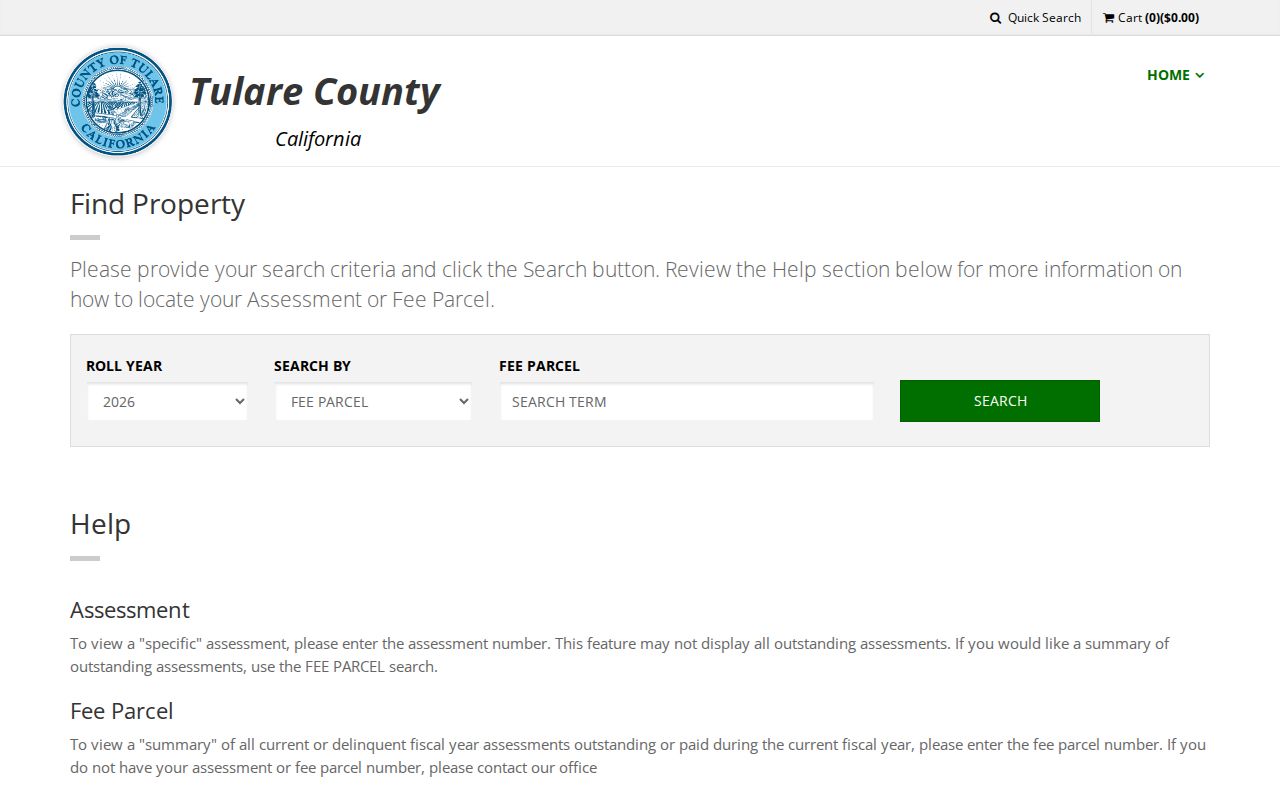
This screen confirms that a tax inquiry is driven by property identifiers. It should not be described as a countywide owner-name directory.
Tulare Court Records Need Fallbacks
The Tulare Superior Court Case Index Search requires login or registration. Public terminals remain available when web access stops there. Files can also be requested online, by mail, or at the counter. A case number is strongly preferred. Without one, a clerk name search that takes more than ten minutes costs $15 per name.
The court’s records-request instructions explain the case-number requirement, copy fees, and terminal route.
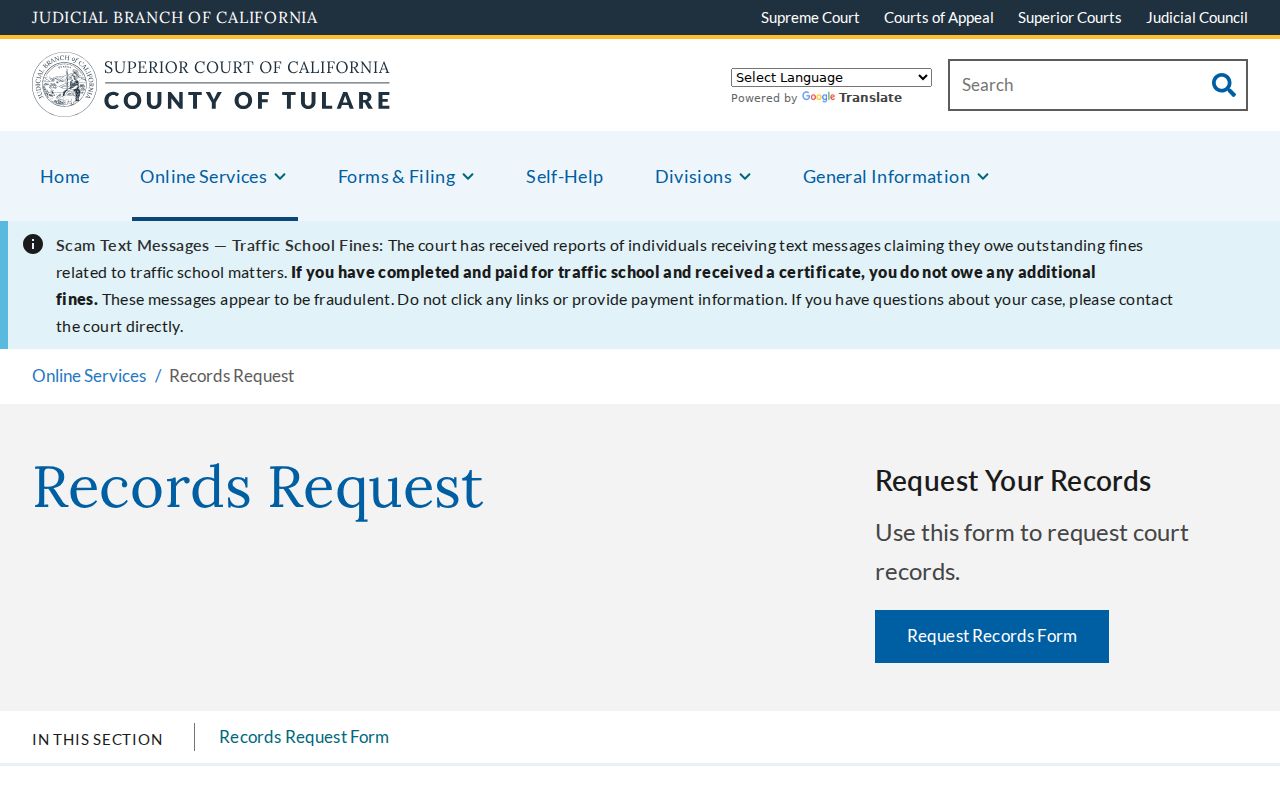
Those channels cover active and archived public files, but the court warns that a destruction program means some older files no longer exist. Sealed, confidential, and juvenile matters do not become open through the request form.
The Tulare court web form asks for request type, case details, requester contact information, and the exact documents sought.
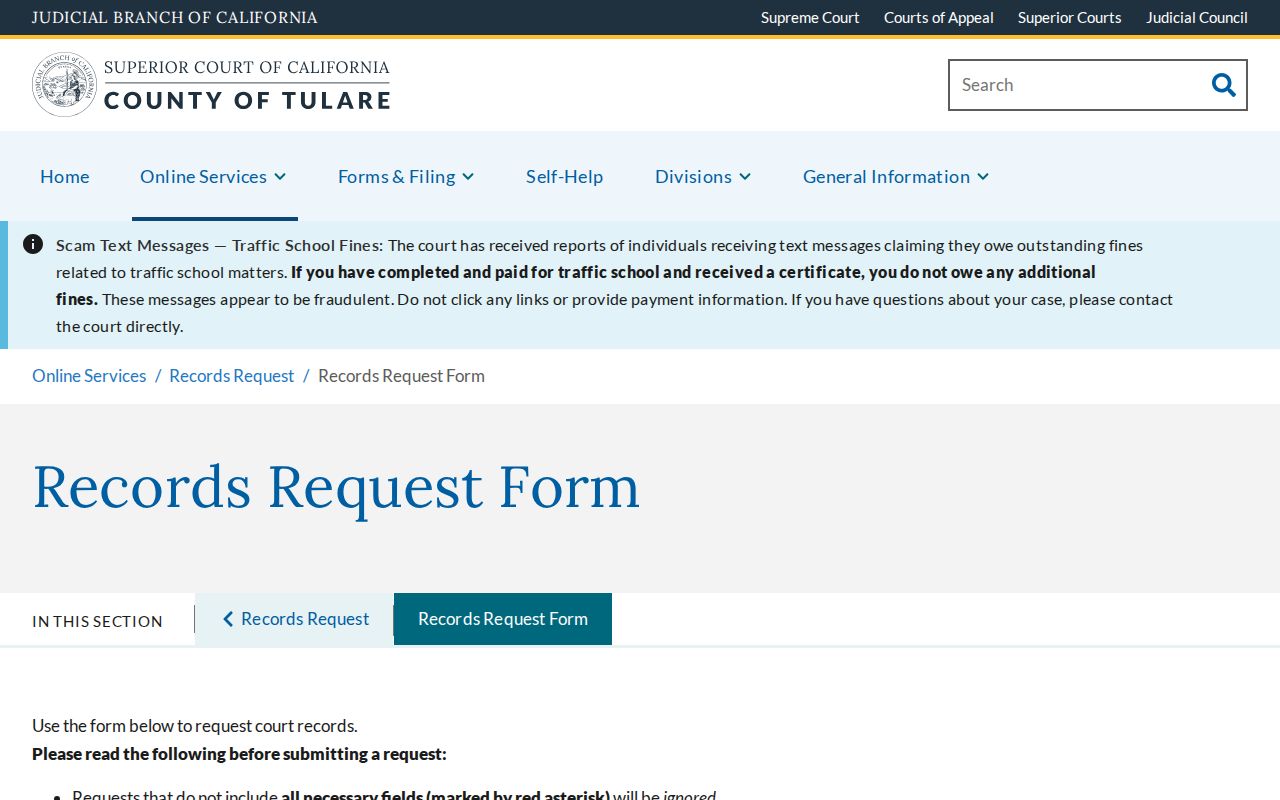
The form will not release confidential records. Mail requests also need a self-addressed stamped envelope and take about 15 business days after request and payment.
Tulare Vital Records Open in Layers
Tulare County uses two local vital-record custodians. HHSA Vital Statistics registers births and deaths and issues records for the current and preceding year. The Clerk-Recorder maintains all years and handles marriages issued in the county. CDPH Vital Records is the statewide route. Divorce decrees come from Superior Court; CDPH’s limited 1962 through June 1984 divorce certificate is only a record of filing, not the judgment.
Health and Safety Code section 103526 separates authorized from informational copies. An authorized copy can establish identity and requires an eligible relationship or legal role, plus a sworn statement and notarization for applicable mail orders. Others may receive an informational copy marked as invalid for establishing identity. Confidential marriages are narrower: only a party or someone with a court order may obtain the copy.
The Tulare County HHSA Vital Statistics page was updated July 6, 2026 and publishes its current service and fee details.
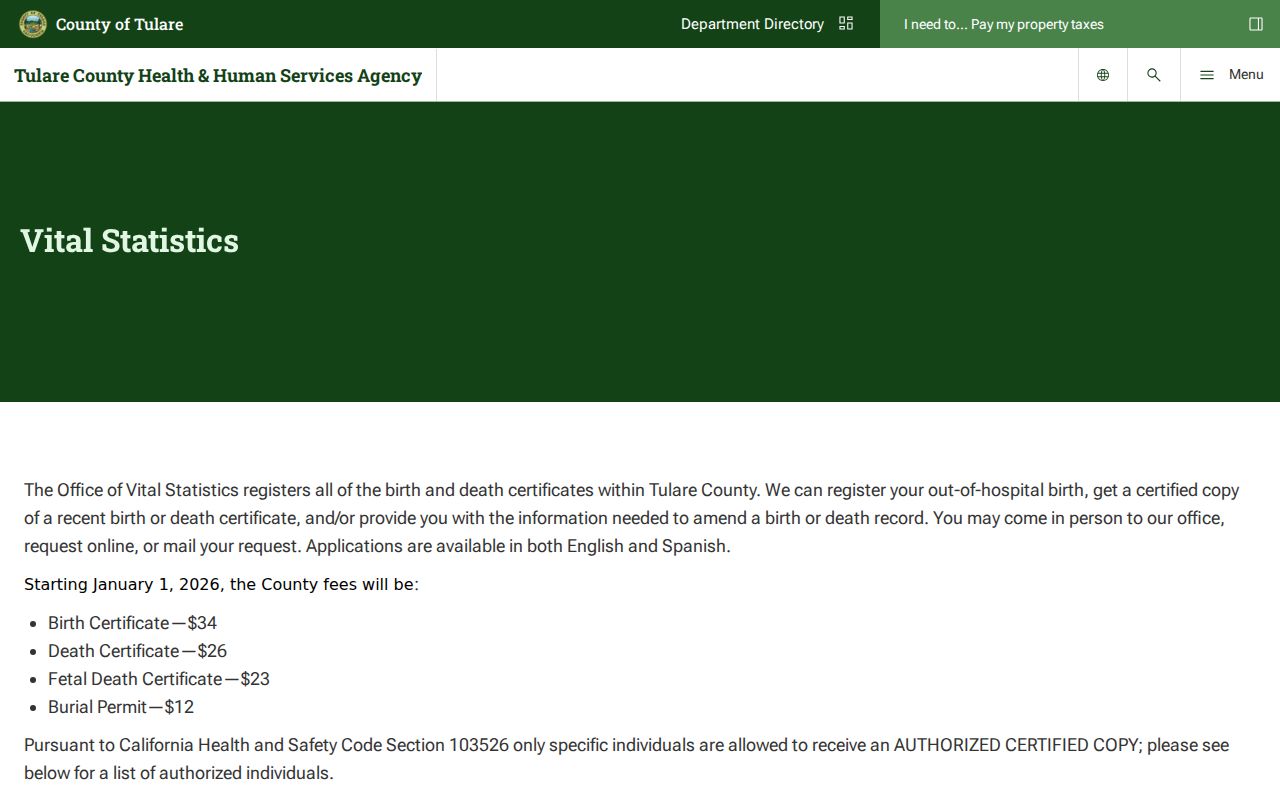
For 2026, HHSA lists $34 for a birth certificate, $26 for a death certificate, $23 for fetal death, and $12 for a burial permit. Applications are offered in English and Spanish.
Tulare Public Records Custodian Desks
Most core county counters share the Mooney Boulevard complex in Visalia, while city requests stay in Tulare. Filing and certificate hours can be shorter than the building’s general office day, so the service window matters.
Tulare County Recorder
221 S. Mooney Blvd., Room 103
Visalia, CA 93291
(559) 636-5050
Tulare City Clerk
411 E. Kern Avenue, second floor
Tulare, CA 93274
(559) 684-4200
The Recorder and County Clerk generally open Monday through Friday, but filing and certificate issuance end at 3 p.m. City records may be inspected at City Hall from 8 a.m. to 5 p.m. on regular weekdays.
Tulare Custody and Safety Records
The Tulare County Sheriff inmate search lists current custody entries with jacket number, name, birth date, booking date, arresting agency, and a view link. It is not a complete past-arrest archive. The Sheriff’s Records Unit separately handles incident reports and Public Records Act contacts at (559) 802-9400.
State custody records use CDCR’s CIRIS lookup, which may show name, CDCR number, age, current location, commitment county, admission date, and parole-hearing information. California’s Megan’s Law service has its own legal limits and should be used only as the public-safety registry the state created. City of Tulare police reports go to Police Records at (559) 684-4238, not the City Clerk’s general file queue.
Note: Booking details can change fast, so confirm a current status with the agency that operates the custody system.
Tulare Public Records Copy Costs
Fees depend on the custodian and the kind of proof requested. The Recorder charges $3 for the first page of one document, $1 for each added page, and $2 to certify it. Certified copies purchased through the portal must be picked up within 14 business days. Mail requests require a check or money order, and no cash should be mailed.
Court noncertified copies cost $0.50 per page per side. A certified divorce judgment costs $15 plus page fees. Most other certified court documents cost $40 plus copies. Tulare County agency paper records cost $0.50 for the first standard page and $0.10 for each added page, while electronic county records have no listed charge. City paper copies are $0.10 black and white, $0.25 color, and $6 per CD; city inspection and electronic delivery are free unless another lawful fee applies.
Check the official rate first. A private deed-copy offer may cost far more than the Recorder’s stated charge. Verify the document number and fee with the custodian before paying.
Historic Tulare Records Leave the Web
Online coverage is not the age of the record system. Tulare County was organized in 1852, and State Archives holdings reach deeds from 1854 and homesteads from 1879. Those dates precede the modern Recorder portal by more than a century. Some archive microfilm lacks a name index, so a date, property description, or family location can be important.
Tulare Public Library adds city and phone directories, vital and cemetery indexes, surname files, newspapers on microfilm, and subject files. Tulare County Library’s Annie R. Mitchell History Room accepts research and obituary requests. A historical land or estate inquiry may therefore move among the State Archives, the county counter, court probate files, and library sources.
The absence of a web result does not prove that no record was made. It may mean the record predates the portal, sits on microfilm, is stored offsite, or was lawfully destroyed under a retention schedule.
California Limits Some Tulare Records
Open-government law has firm boundaries. Juvenile dependency and delinquency files are confidential. Courts exclude sealed matters and some family details. Adoption records use special legal procedures. Confidential marriage copies are limited to the parties or a court order. Motor-vehicle information is protected by federal and state privacy rules.
Voter registration data is another special category. Government Code section 7924.000 and Elections Code section 2194 keep home addresses, phone numbers, email, identifying numbers, signatures, and protected voter files outside ordinary public access. Approved voter-file recipients must qualify for a permitted election, scholarly, journalistic, political, or governmental use. The dedicated Tulare voter registration resource covers that separate request system.
California Safe at Home gives eligible participants a substitute mailing address and related confidentiality. A redacted field or denied request may reflect one of these laws, not a failure to search.
Request Tulare Public Records
Government Code section 7922.535 gives a California agency ten days to determine whether responsive, disclosable records exist. A written extension of up to 14 days is allowed for unusual circumstances. Section 7922.530 calls for prompt access to identifiable, nonexempt records and generally limits charges to direct duplication cost or another fee set by law. A determination is not always the same as final production.
Use the city form for Tulare municipal departments. County agency requests go through the Clerk of the Board and Tulare County NextRequest. Court, Recorder, vital, police, and voter records follow their own channels because their custodians and access statutes differ.
- Name the custodian. Decide whether the record belongs to the city, county, court, or state office.
- Check the official index. Capture a case, parcel, document, or assessment number when one is available.
- Describe the record. Give a clear subject, date range, document type, and known identifier. Ask for existing records rather than a new analysis.
- Choose delivery. Request inspection, an electronic file, paper copies, or certification as the office allows.
- Review the response. If material is withheld, ask which exemption applies and consider narrowing an overly broad request.
Use records lawfully. Access supports family history, estate work, consumer verification, civic review, and personal safety. Never use a record to stalk, harass, threaten, or harm another person.